Friday, August 24

Lamentations for Iraq

A fragment from an ancient Mesopotamian lamentation:

"Dead men, not potsherds
littered the way.
In the wide streets
where the crowds once gathered and cheered,
the corpses lay scattered.
In the fields where the dancers once danced
the dead were heaped up in piles......."

Iraq has been in dreadful places before, it has recovered and it will recover.

Thursday, June 14

UK Iraq Commission

The Foreign Policy Centre (a Labour Party think tank) and Channel 4 are currently running the UK Iraq Commission - described as a British version of the US Iraq Study Group, but with the difference that the hearings are broadcast and the timescale is much shorter, just 6 weeks so as to produce a final report soon after Gordon Brown becomes Prime Minister. There are some very interesting witnesses and submissions, quite a few from my friends, so I highly recommend watch and reading some of them. I was planning on making an submission, but have been preocuppied with work on Gaza the last few weeks and so haven't managed to do so.

Wednesday, May 16

Change of identity

To those who've been redirected here from my old site, and to anyone who has just stumbled upon this page, Ahlan wa sahlan, blogi blogkum (a warm welcome, please consider my blog as your blog) - okay that greeting doesn't work so well for virtual rather than physical guests! I'm kinds busy at the moment with multiple reports, projects and campaigns on the go, so won't probably won't write anything for a few weeks, but you know where to find me now!

My old blog title didn't make as much sense as it used to. Back in 2003 when there was some hope of the Occupation ending quickly and a peaceful and prosperous Iraq emerging, that slightly tongue in cheek title was intended to emphasis how much I value Iraq and Iraqis - I'd actually like to be one of them! Honestly I imagined living out in Baghdad for much of my life, firstly supporting the rebuilding of the country (which I feel a responsibility to be involved in, as a result of the damage caused in part by Britain over the last century and particularly the Sanctions and wars during my lifetime) and secondly enjoying the richness of culture and the warmth of the people in the cradle of civilisation. After four long years of bloodshed that seems so unrealistic that the title now sounds very strange and might even seem to be sarcastic. Hence I've changed it.

Monday, April 16

"Misunderstanding Islam" broadcasts

An old school friend, Rich Ward, has recorded a radio mini-series for BBC Radio Oxford challenging some of the misrepresentation of Muslims in the media. Its available online for the next week here.

Monday, March 19

Marking the 4th anniversary of the invasion

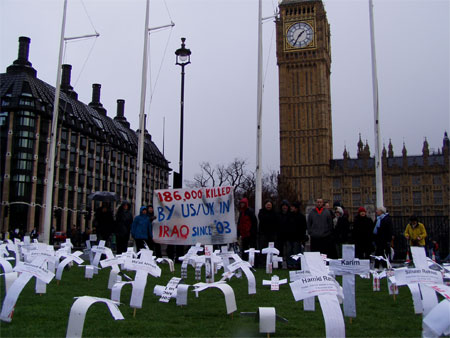
Together with friends from Voices in the Wilderness, Catholic Worker and Fellowship for Reconciliation I helped plant 186 crosses in Parliament Square to remember those killed in Iraq. Each cross had the name of a known victim and together they represented the 186,000 estimated to have been directly killed by Coalition forces (estimated from a survey published in the Lancet in October 2006 which estimated a total death toll of 655,000). My close friend Salih, and Iraqi doctor from Basra, mournfully participated and updated me on the latest horror stories from his friends and family in Iraq - the hospital were he trained in Basra is nearly empty as most doctors have been killed or have fled. The crosses in the picture looked battered because there was strong wind and hail while we were errecting them - the ragged look is perhaps more suited to Iraq's devestation than tidy military-style rows of gravestones. A photo of the crosses appeared in the Metro this morning, and the event is written up by Ekklesia and Indymedia.

Monday, February 26

Identity in Christ

When I began to get acquainted with Jesus in my mid-teens, I was in a pretty miserable state. I had a very low self esteem because I didn't match up at all to the sporty, trendy and confident standard expected at my boarding school. I had been quite heavily bullied and felt no one valued me, and consequently was fairly self-absorbed. One of the amazing things I discovered as I began to get to know some Christians was how precious and unique I was to God. For example Jesus illustrates the Father's deep love for us by saying that he even counts the number of hairs on our heads, he calls us children and friends rather than servants. And the Bible contained phenomenal statements about how differently God saw me (compared to the negative way other people might) and promises about how he was transforming me to become more like Jesus.

Back in my school days I gathered together a page of my favourite quotations from the Bible related to the new identity I'd come to embrace as someone loved by God. It's clear from the context that many of the verses in the Bible, for example things Jesus says to his little band of disciples, are intended not just for the immediate audience but also apply to us today. This is not always the case of course, and I have no intention of building a giant wooden Ark because I've read that Noah was once asked to do this! Anyhow, for those verses which were clearly universalisable, I look the liberty of replacing pronouns like "you" with my own name as a reminder that amazingly these truths and promises really were meant for me as well (and you too)! I wrote as an introduction that: "God treats us as individuals, He knows everything about us, yet He loves us and has made it possible for us to come into relationship with Him." I sometimes made similar sheets for friends, and they were generally well appreciated.

When I first put together a website, almost a decade ago, this sheet was one of the first pages I posted up on it. I'm mentioning it now because I just got an email from a guy in the US who stumbled upon this page via Google. He has transformed it into an online form which will generate a list of those personalised verses which can be viewed on a webpage and/or sent by email. It's a great idea, so thanks Jacob!

Sunday, February 11

My letter about Islam in the Daily Mail

I was just (vainly) doing a search for my name online and I discovered that a letter I wrote to the Daily Mail last month was published (in a somewhat edited form) under the title "Peaceful Majority". As I didn't get a response from them, and don't read that newspaper, I hadn't realised it was actually published!

It was written after the excellent Arab Media Watch sent an alert about a column of his that said: "The chairman of the U.S. House Intelligence Committee was forced recently to admit he didn't know the difference between Sunni and Shia... So, for the benefit of Mail readers in the same boat, here is a simple cut-out-and-keep guide to the two dominant branches of Islam: Sunnis are the peace-loving, Saudi-backed wing who brought you Al Qaeda. Shias are the peace-loving, Iranian-backed strain behind Hamas and Hezbollah. I hope that helps."

My letter said: "I was shocked to read Richard Littlejohn's characterisation of the two main branches of Islam, implying that neither is 'peace-loving'. One might as well describe Christians as being 'behind the IRA and Ku Klux Klan'. Muslims who commit violent acts are not at all representative of the vast majority of the 1.3 billion Muslims worldwide - almost a quarter of humanity. And Hamas isn't a Shia organisation: it is composed entirely of Sunni Muslims."

One line that was unfortunately cut from the published letter was: "I have worked in Palestine and Iraq with outstanding Muslims of both sects whose faith inspires them to risk their lives non-violently in the cause of peace and reconciliation."

Sunday, January 28

New Iraq blogs

I've started two new blogs related to projects I'm working on. One is an initiative to evacuate the Palestinian community from Baghdad and the other is a campaign against rip-off privatisation of Iraq's oil fields.

Thursday, January 18

Public Meeting on Iraq in Parliament

I'm speaking at a Public Meeting on Iraq in the UK Parliament next Tuesday (23rd Jan, 6-7.30pm, Committee Room 16). It's been organised by Iraq Occupation Focus to brief MPs prior to an adjournment debate on Iraq in the House of Commons on the following day. The others on the panel are Haifa Zangana (an Iraqi writer), Greg Muttitt (author of 'Crude Designs: The Rip-off of Iraq's Oil') and Glen Rangwala (co-author of 'Iraq in Fragments: The Occupation and Its Legacy').

Saturday, December 30

Eid Mubarak

I wish all my Muslim friends and readers God's blessings on Eid al-Adha (The Festival of Sacrifice)!

It's an important festival which I think Christians should also celebrate. It remembers the day that Abraham did not sacrifice his son (Issac or Ishmael, depending on you preference). The focus is often on the obedience and faith of Abraham in his willingness to give to God that which he cared about the most. This is certainly an important part of the story, but I think another perspective on it is even more significant. People often wonder why God should ask Abraham to prepare to do such a horrible thing (building the altar, tying his son to it, raising his dagger to kill...) even if he granted a last minute reprieve? I think this question reveals the great truth behind of Eid al-Adha. Abraham lived in a time when human sacrifice, including child sacrifice, was central to most of the religions of the day. God was giving Abraham a very clear lesson: He was not that kind of deity. He is the God who creates, and life is precious to him.

How ironic then, that in a day that we remember a life being spared, in Iraq a life was taken. I was no fan of Saddam. I know many people who suffered directly and indirectly because of his harsh rule and, but for his regime (and the reaction of other countries to it), Iraq might today be a wealthy and peaceful country, the cradle of civilization. However executing him does not undo the damage. In fact in the long term it may inhibit the healing process for Iraqis, who will now not have the chance to have the wrongs done to them because of Saddam heard in court. Saddam is of course not the first person to be executed. There are of course many serious crimes such as murder and kidnapping being committed daily in Iraq, and the Iraqi courts are handing out the death penalty frequently and often on a tiny fraction of the evidence and judicial process that existed for Saddam. I have lost many friends in Iraq in recent years, and I can relate to the desire for punishment and revenge. But sadly I doubt this will set the foundation for the peaceful Iraq, respectful of human rights, that the long-suffering Iraqis deserve.

I would have preferred the punishment for Saddam that Norman Kember has suggested: for him to be dressed in an orange jumpsuit and put to work on a building site, ending his life repairing in a small way a tiny part of the destruction he brought upon his country. And we could think of a few other leaders closer to home who might justly be expected to join him in laying those bricks.

Sunday, December 24

a little good news on Christmas Day

For a couple of months I've been trying to find someone to pay for the treatment of Badr, a 2 year old Iraqi boy who is the nephew of a friend whose father was killed by US soldiers last year and who has a life-threatening heart condition . Now I've just heard confirmation that, thanks to help from CIVIC, an American medical foundation has agreed to pay for him to be fully treated in a hospital in Ohio! Of course this is a small thing set against the hundreds being killed everyday, but at least this boy has a chance at life.

Saturday, December 23

Friday, December 8

CPT hostages call for forgiveness

I've just been to the press conference in London (at St.Ethelburgas, a church which was destroyed by an IRA bomb and is now a peace centre) where the former CPT hostages, Jim Loney, Norman Kember and Harmeet Singh Sooden called for restorative justice not the death penalty for their former captors:

"We unconditionally forgive our captors for abducting and holding us. We have no desire to punish them. Punishment can never restore what was taken from us. What our captors did was wrong. They caused us, our families and our friends great suffering. Yet we bear no malice towards them and have no wish for retribution. Should those who have been charged with holding us hostage be brought to trial and convicted, we ask that they be granted all possible leniency. We categorically lay aside any rights we may have over them... Kidnapping is a capital offence in Iraq and we understand that some of our captors could be sentenced to death. The death penalty is an irrevocable judgment. It erases all possibility that those who have harmed others, even seriously, can yet turn to good. We categorically oppose the death penalty." (Statement in full)

It is a very clear message and my friend Tom Fox, who was kidnapped with them but killed a few weeks before they were rescued, would have agreed wholeheartedly with it. In response to a question, Norman said "Tom was the most compassionate of the four of us. Whenever we heard a bomb go off somewhere in the city, Tom would immediately pray for both the victims and the perpetrators."

Separately... the BBC today reports on the pioneering grassroots video-blogging from Iraq that my friends Omar and Brian have been doing in Baghdad. Alive in Baghdad was being run from my flat in Amman earlier this year.

Sunday, November 12

White poppy controversy

For years I've been quietly wearing a white poppy in the run up to Remembrance day (the 11th November, when Britons commemorate those who have died in wars, traditionally wearing the Red Poppy of the Royal British Legion which became a symbol due to the flowers that grew in the trenches of the 1st World War). Until this year, most people were unaware of the white poppy's meaning (as only 50,000 are worn annually compared to 10's of millions of red poppies) which is to honour the dead while not glorifying warfare, and expressing a commitment to non-violence.

This year things have suddenly changed with prominent TV personalities such as newsreader Jon Snow refusing to wear a poppy on air, and the fierce backlash in the media to my friends at Christian think tank Ekklesia encouraging churches to stock white poppies as well as red ones to give people the choice of what to wear and stimulate discussion on the myth of redemptive violence (the idea that long-term peace can be achieved through war). Simon Barrow's article "Giving peace a chance proves highly controversial" gives a good overview of the debate. See also the Peace Pledge Union's White Poppy site.

Tuesday, October 31

Interviews from Iraq

Brian has posted up some excellent interviews on his blog with some of my closest friends from Iraq. Merky talks about his detention in Abu Ghraib and Camp Bucca, Majed talks about his first experiences after the war, and Sami of Muslim Peacemaker Teams relates the amazing story of a brave Sunni who died rescuing drowning Shias after a bridge collapse.

Friday, October 27

New opportunities for me, none for Iraq

Apparently my sister-in-law in Ohio regularly checks this blog for updates and has told me off for not writing more often. I've got a little to report today, as it's my last day working on Peacemakers and next week I'm starting work on From Crisis to Opportunity, a new project of the Oxford Research Group to develop more inclusive and legitimate approaches to conflict in the Middle East.

A bigger development for us is that Jenny is now in her third week with a small and quirky accountancy firm which focuses on auditing charities. As it will take Jenny three years to qualify as a chartered accountant, it looks likely that we will be staying in London for at least that long - also conviniently about the time needed for Jenny to get British citizenship.

Looking beyond our little lives, I haven't really got anything coherent to say about Iraq today. I'm in a catatonic state these days as the violence continues unabated. Rather than reading a rant from me, I direct you instead to my friend Zaid al-Ali's latest article on Opendemocracy critiquing Peter Galbraith's book on dividing Iraq. Also visit Riverbend who has blogged at last after a 2.5 month hiatus that got us all worried for her, and Jeff's new blog War Every Day on Electrionic Iraq. The BBC aired a powerful and distressing documentary this week filmed by a doctor in Yarmouk hospital in Baghdad - it shows the real results of the violence in Iraq which we rarely see.

If you are in London on Sunday go and join in the No More Fallujah's peace camp outside Parliament. I might join it if I can get back in time from Birmingham where we're doing a workshop on CPT at a Fellowship of Reconciliation conference.

Monday, September 25

Palestinians with no where to flee

Human Rights Watch has just published a report No Where to Flee: The Perilous Situation of Palestinians in Iraq. Through Christian Peacemaker Teams I've had close contact with many Palestinians in Iraq and know those who are in hiding in Baghdad, stuck in border refugee camps and a very few who have made it safely out of Iraq.

Wednesday, August 30

We will not be silent

Before the Monarch flight debacle there was another example of Islamophobia on a flight from New York to San Francisco on August 12. My close friend Raed Jarrar, a secular Iraqi-Palestinian who was groomsman at my wedding in June (when you follow the link he's on at the top of the steps in the first photo throwing confetti and on the left of the second photo), was flying back from NY to rejoin his American wife Niki in San Francisco. He is a prominent figure in the peace movement and was wearing a T-shirt saying "We will not be silent" in English and Arabic (a slogan first used by opponents to Nazi rule in Germany). But JetBlue airlines decided to silence him, insisting that he remove his T-shirt in case it worried other passangers. Raed explained "I grew up and spent all my life living under authoritarian regimes and I know that these things happen. But I'm shocked that they happened to me here, in the US." (see his blog for more). You can call JetBlue on 001-801-365-2525 to ask them why he was treated like this. The Arab Anti-Discrimination Committee have lodged a formal complaint.

Today the story featured as a front page item on BBC News (and elsewhere)

Wednesday, August 16

Peacemakers

I've just started working on a project Peacemakers launched after the 7/7 bombings in London last year to build bridges with the British Muslim community. It's a range of multi-media products (films, commericals, a photo exhibit, a music video, teachers guide book etc.) showcasing the lives of ordinary Muslim, Christian and secular Brits and peacemakers from these communities. The materials are due to be completed towards the end of the year and I'm working on organising consultation with stakeholders (particularly the Muslim community) and figuring out how to best distribute them through schools, churches, broadcasts etc.

If anyone reading this is going to be at Greenbelt this bank holiday weekend, I'll be hanging about the Peace Zone with friends from Christian International Peace Service and Christian Peacemaker Teams UK and others, so come and say hello!

Wednesday, July 26

What to do for Lebanon?

(1) Stay informed: Wikipedia, ElectionicLebanon.net, JuanCole.com, DahrJamailiraq.com, beirut.indymedia.org, lebanonupdates, Siegeoflebanon, Tadamon, Daily Star (Lebanese paper), Haaretz (Israeli paper), Jerusalem Post (right-wing Israeli paper), IsraellyCool, Lebanese Bloggers Forum, Lebanese blog Aggregator

(2) Protest the war. You can do this in demonstrations, letter writing etc. to your own government officials and to Israeli embassies. Some resources for this: www.saveleb.org, www.stopwar.org.uk

(3) Support refugees. At least a quarter of the Lebanese population of 4m have fled the country to Syria and beyond or been internally displaced. There are hundreds of thousands squating in schools and other buildings in Beirut with dwindling supplies. Here are some good organisations working with them you can donate to: FDCD, Sanayeh Relief Center, ICRC, Christian Aid, Toys for refugee childen (set up by some friends in Jordan)more donation options

(4) Remember the dead. I'm looking into establishing a Lebanon Body Count, similar to Iraq Body Count, to use media reports to create a record of all those killed (including Israeli civilians). If you'd like to volunteer to help with this let me know. We particularly need people who also speak Arabic/French. Israeli peace activists would be particularly welcome.

(5) Assert the rule of law. Some Lebanese friends are working to systematically document the damage caused by this war to people and property, with a view to making legal redress. Unfortunately it is very difficult to bring cases related to war crimes when a country such as Israel doesn't sign international treaties and otherwise immunises itself, however it's important that we try. Lawyers to research options for cases against the Israeli government, soliders or officials, as well as potential volunteers to help with the documentation on the ground in Lebanon would be particularly helpful. See Sue Israel. Also see excellent reports by Human Rights Watch on war crimes being committed.

(6) Peace March to the South. A group of Lebanese friends are looking into organising a march from Beirut to Qana and possibly to the border (ideally to be met by an Israeli peace march from the South) to highlight the plight of civilians trapped by fear and destroyed roads in the Israeli kill zone, remember all the dead and demand a ceasefire. If this happens international accompanyment and publicist in the media will be critical - consider if you can fly out to the region within the next week, maybe get a Syrian visa and look into flights in preperation. UPDATE: A similar idea is being developed by www.lebanonsolidarity.org who are planning convoys to the South on 12th and 19th August.